
Huntington Directory Years on Record
The West Virginia State Archives city-directory inventory is the clearest starting list for Huntington city directories. Its holdings begin with a 1913-14 edition and continue in selected years through 2016. Coverage is uneven. A year inside that span is not automatically held, so note the exact edition before planning a visit or request. The Cabell County Public Library and Marshall University add local books, photographs, yearbooks, maps, clippings, and vertical files that can explain a brief directory line.
| Collection | Years | Where Held | Access |
|---|---|---|---|
| Huntington city directories | Selected editions, 1913-14 to 2016 | West Virginia State Archives | Archive holdings; confirm the edition |
| Local-history books and directory help | Dates vary by item | Cabell County Public Library | Staff request or local access |
| Cabell-Wayne Historical Society files | 1880s-1974 | Marshall Digital Scholar and Special Collections | Digitized subset; more material on site |
| Maps, yearbooks, and business history | Dates vary by collection | Marshall Special Collections | Contact staff; some items are online |
The archive list includes 1917, 1924, 1928, 1930, 1940-41, 1947, 1949, 1956-57, 1960, 1964, most years from 1967 through 1981, and later groups through 2016. It does not claim annual publication or complete survival. Describe a failed search as “not found in the editions checked.” That wording leaves room for a missing volume, variant spelling, unreadable scan, broader regional edition, or an unlisted household.
Huntington Directory Help at CCPL
The Cabell County Public Library Local History Collection offers a focused staff search when a researcher cannot work through the volumes in person. Staff will search one individual in city directories for no more than five years. If the name is not found, they may send surname pages instead. This limit is useful: supply the full name, name variants, likely address, and a tight year range rather than asking for an open-ended life history.
Copies have distinct costs. The research notes list microfilm at $0.25 per page, photocopies at $0.15 per page, fax service at $1 for the first page and $0.50 for each added page, and a CD-R at $1. For people outside the service area, limited research of up to four microfilm pages or six photocopies carries a suggested $5 donation. Confirm current charges before ordering. Phone, staff request, and an in-person visit remain the fallback channels when a volume is not digitized.
The library's local-history page is the source for those request limits and collection descriptions.
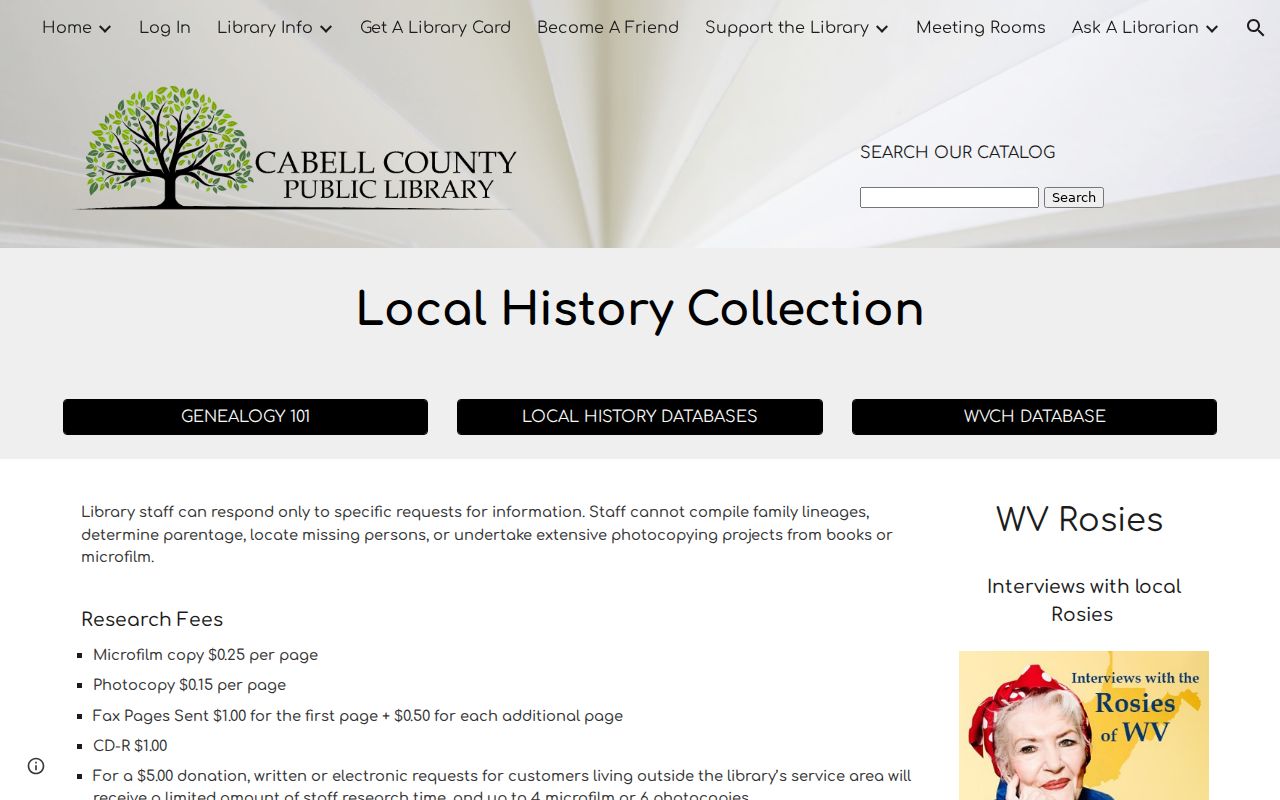
Its service details help frame a narrow request before contacting staff.
Marshall Files Enrich Huntington Directories
Marshall University Special Collections, in Morrow Library at One John Marshall Drive, holds maps, flood photographs, transportation and business history, and yearbooks. Staff can be reached at 304-696-2343 or speccoll@marshall.edu. These sources do not replace a Huntington city directory. They explain what an address, firm, school, rail line, or institution meant in the year of the listing.
The digitized Cabell-Wayne Historical Society collection covers material from the 1880s through 1974, including clippings, obituaries, church directories, photographs, court-record files, census and genealogy material, and regional organizations. Only part of the collection is online. For an undigitized lead, contact Special Collections with a surname, topic, place, and date range. A church roster or yearbook may confirm an association, while the city directory supplies the dated address line.
The Marshall Digital Scholar collection landing page shows the online route into that selected material.
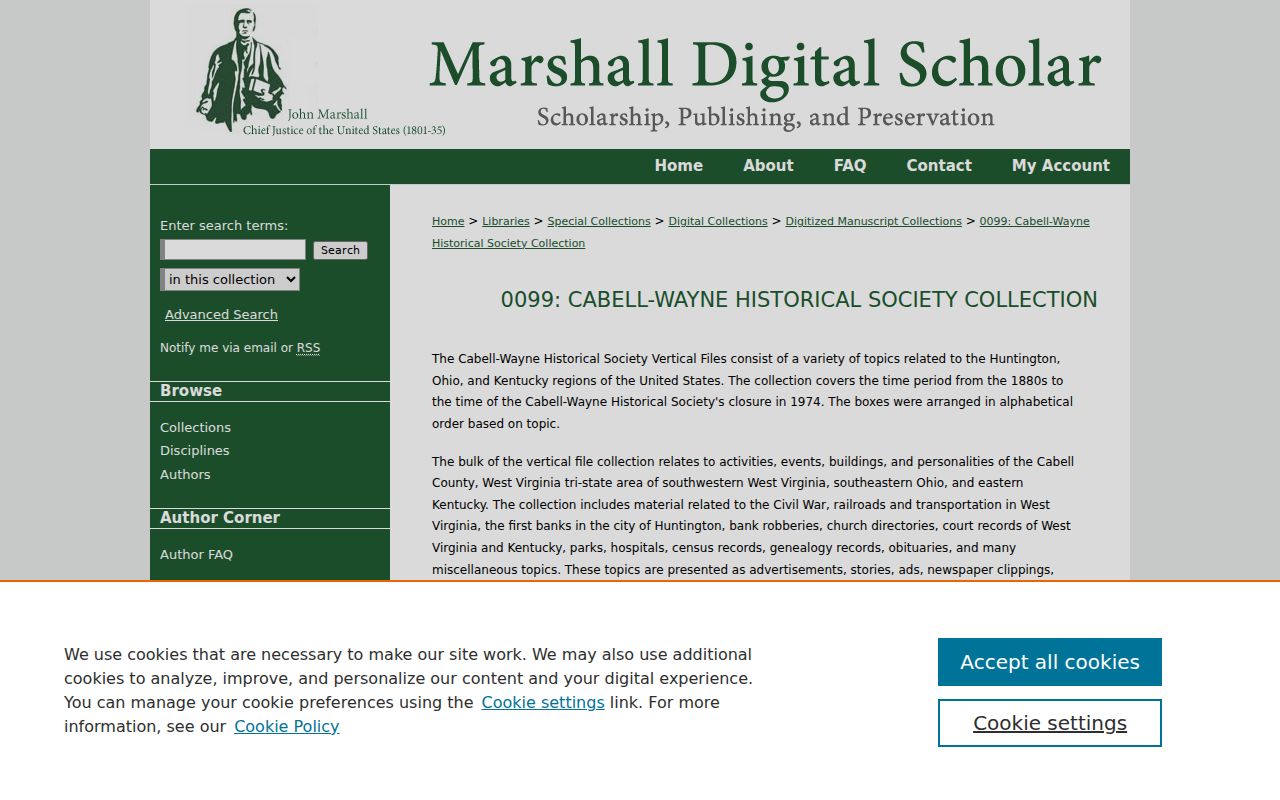
The online subset is a finding aid and research source, not proof that the physical collection contains no other relevant file.
The official Huntington holdings and the society files serve different roles. Keep both labels in notes. “Historical directory” means a dated name or street entry; “archive context” means a separate photo, clipping, map, or institutional record.
Flood Years in Huntington Records
The library identifies photograph groups for the 1913 and 1937 floods, and Marshall also holds flood images. These collections add a strong local layer when an address disappears, a business shifts, or a street scene changes between directory editions. A flood photograph can show a structure, sign, road condition, or public event. It cannot identify every person who lived there.
Use the photo title and date beside the city directory citation. The West Virginia University Libraries digital flood item shows how a catalog record preserves creator, date, and collection context. Pair that context with the nearest available directory years, then look for a date-specific newspaper account. This evidence may explain a physical change without turning an image caption into a resident list.
Decode a Huntington Directory Entry
A directory line is compact and edition-specific. Read the abbreviation key before expanding any mark. Search both surname and street sections when they exist because a person may appear under a family household, business, or institution. Copy the printed spelling, page, edition year, and volume scope. Do not assume that every volume uses the same marks or covers only the legal city boundary.
| Printed name | The indexed person or household name, copied exactly as shown. |
|---|---|
| Occupation or firm | A historical work or business association for that edition. |
| Street address | The house number and street then printed, which may need later map checks. |
| Household notation | A spouse, widow, boarder, or other printed relationship, interpreted through the key. |
| Edition context | Publisher, year, page, and whether coverage extends beyond Huntington. |
- Criss-cross directory
- A later directory section arranged by street and house number instead of surname.
- Householder index
- A list centered on the named person associated with a household in that edition.
- Abbreviation key
- The volume's own guide to shortened words and symbols. Save it before interpreting an entry.
Marks describe the publisher's category, not a fact that should be carried forward to another year. When a current address search is needed, use the Huntington street directory workflow and official parcel sources.
See Huntington City Directory Holdings
The State Archives holdings page provides the edition-level list used to choose a search year. It is an inventory, not a scanned name index.
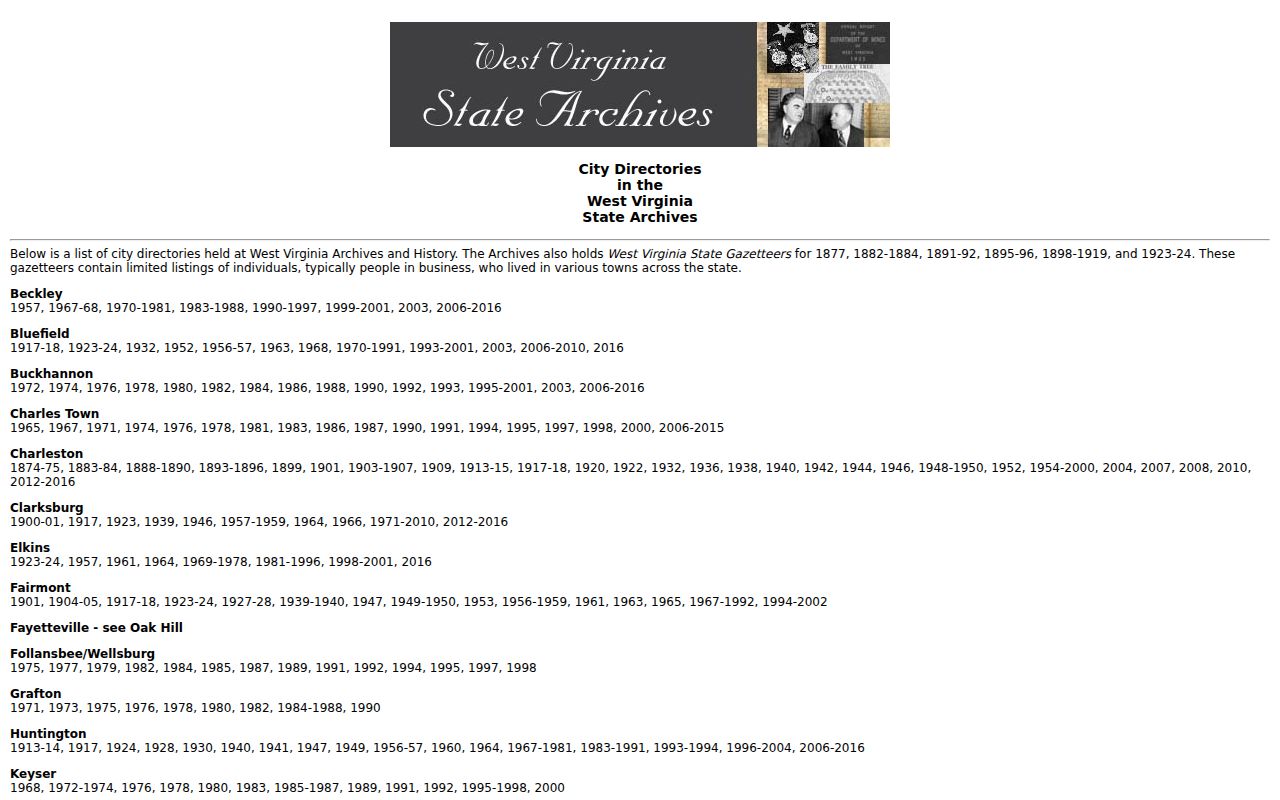
Use the visible year list to plan the next archive, library, or staff request and retain the exact edition in every citation.
Huntington Directories Meet Newspapers
Newspapers can explain why a name appears, changes address, or vanishes between two editions. Cabell County Public Library requires a complete date for obituary or death requests. If the exact day is unknown, staff search one newspaper over five days. The Herald-Dispatch is not indexed there, so a date-specific request is essential for news research.
State Archives microfilm spans many Cabell titles and years, but a listed run may contain selected dates or missing issues. No result in one reel is not proof that an item was never published. Start with a date from the Huntington city directory, obituary, vital record, or event file. Record the newspaper title, issue date, page, and whether the reel was complete for that interval.
For older historical work, the sequence is straightforward: dated directory entry, nearby newspaper issue, obituary if relevant, then the proper deed, court, or vital custodian. Each item should keep its own relationship label.
Huntington Directory Trail Through Time
Huntington became Cabell County's seat after the county formed in 1809, and the city was incorporated in 1871. The surviving record trail grew from county deed, tax, court, vital, and probate books into newspapers and city directories, then into library and university collections. This short timeline shows which type of source can support a directory finding.
| Period | Useful Huntington record layer |
|---|---|
| 1809 onward | Cabell land, deed, tax, court, and probate series at the Clerk and State Archives |
| 1884-1931 | Sanborn fire-insurance maps for streets, structures, and building use |
| 1913-2016 | Selected Huntington city directories in the State Archives inventory |
| Modern access | Distributed archive, library, university, county, and state portals |
These date bands overlap, but they do not fill every year. A 1910 address may require deed, newspaper, and map work because the official directory list begins later. A gap is a source limit, not evidence of a move.
Trace Family Through Huntington Directories
Family research works best when each Huntington city directory entry is treated as one dated observation. Begin with the closest known year and copy the line exactly. Then compare the next available edition, not simply the next calendar year. A middle initial, spouse notation, firm, or address can separate people who share a name. Census records can fill a decennial checkpoint, while yearbooks, church directories, obituaries, and local-history files add context between editions.
- Choose a known name, address, or year and select the nearest edition in the archive inventory.
- Check surname variants and copy the whole entry, page, publisher, and year.
- Compare the next held edition, then use a street-order section when one exists.
- Pair the directory years with census, yearbook, church, obituary, or newspaper records.
- Verify any deed, vital, probate, or court conclusion with the office that keeps that record.
A disappearance has several possible causes: a move, death, changed surname, household listing under another person, missed publication, missing edition, or simple omission. Do not choose one without another source. The careful conclusion is limited to the volumes checked and the dates they represent.