
Huntington Address History Sources
Choose a source near the year being studied. A current parcel card is excellent for entering a deed chain, but it cannot by itself identify previous residents. Historical directories may show a dated household listing. Land books add ownership and tax context, while a Sanborn map describes the building and its use. The ranges below are official holdings, not a promise that every year, name, page, or image is online.
| Source | Years It Covers | Where Held | What It Shows |
|---|---|---|---|
| Cabell deed index | 1808-1968 archive range; live cutoff unpublished | County Clerk and State Archives | Grantor, grantee, deed references |
| Cabell deeds | 1809-1901 archive range | State Archives; Clerk for current series | Transfers, legal descriptions, prior instruments |
| Huntington directories | Selected editions, 1913-2016 | State Archives and county library | Dated name and street listings |
| Cabell land books | 1809-1900 | State Archives | Land and tax context, not occupancy |
| Sanborn maps | 1884-1931 located set | WVU and Library of Congress | Building footprint, use, and street context |
For a late twentieth-century question, start with the closest available directory year and bridge to a deed. For an earlier parcel, legal descriptions, land books, maps, and newspapers carry more weight. Write down exactly which edition or book was checked. "Not found" should always identify the holding and date range.
Use a simple evidence log: source title, edition or series, date searched, relationship shown, and any missing interval. This prevents a tax owner from being blended with a directory householder. It also makes the next archive or clerk request precise enough for staff to act on.
Date Huntington Past Residents
A target year prevents a current search from swallowing the historical question. Record the address as known then, the person's name if any, and nearby dates. Search both the original spelling and a normalized form. Test directionals, numbered streets, unit numbers, and shortened street types. A historical place may be labeled Guyandotte, Central City, West Huntington, or by a postal name that differs from today's municipal boundary.
No dated, authoritative Huntington street-renaming or renumbering list was located in the reviewed sources. Treat a suspected change as a research question. City council, planning, and newspaper records may resolve one street at a time, but an assumed conversion can attach the wrong family to the wrong lot.
Huntington Previous Residents Between Volumes
The West Virginia State Archives inventory lists Huntington editions for 1913-14, 1917, 1924, 1928, 1930, 1940-41, 1947, 1949, 1956-57, 1960, 1964, 1967-1981, 1983-1991, 1993-94, 1996-2004, and 2006-2016. These are uneven runs. A gap between volumes is not proof that past residents moved.
Cabell County Public Library Local History will search one person in city directories for no more than five years. If staff find no entry, they may send surname pages. That limit is a useful way to define a focused request. Longer work should be split into sensible windows or continued through archive access.
Trace Huntington Past Owners Backward
Begin with the state assessment search, which can expose a Cabell parcel, current tax-year owner label, physical address, legal description, and deed book/page. Then move to the Cabell County Clerk record-room index. Read the deed image when public and transcribe its parties, date, legal description, prior instrument, easement, right-of-way, and map reference. Ownership does not prove that the named party lived there.
- Save the current parcel ID, owner label, legal description, and deed book/page.
- Find that instrument and identify the grantee who received and the grantor who conveyed the interest.
- Search the seller as an earlier grantee, then confirm the matching land description.
- Repeat through cited prior instruments, noting branches such as corrective deeds, trusts, easements, or survivorship.
- When the index stops or misses a letter run, ask for deed books, land books, microfilm, or archive help.
- Grantor / grantee
- The grantor gives an interest; the grantee receives it.
- Chain of title
- The linked sequence of recorded interests for the same land.
- Legal description
- The deed's formal land description, often steadier than an old street number.
The live index's start year is not published. State Archives lists the Cabell deed index for 1808-1968, deeds for 1809-1901, and land books for 1809-1900. Four named index gaps matter: grantor Sm-Sz, T-U-V, W-X-Y-Z and grantee D for 1808-1922. Use a deed-book strategy when those slices fail.
Map Huntington Previous Residents' Buildings
Sanborn fire-insurance maps date structures and land use, not previous residents. Located Huntington maps cover 1884, 1889, 1893, 1898, 1904, and 1931. Match a map sheet to the legal description, street grid, and nearby landmarks. Then keep the map evidence separate from the person evidence in a directory or newspaper.
Open WVU's Huntington Sanborn record, which also provides remote and appointment contact options.
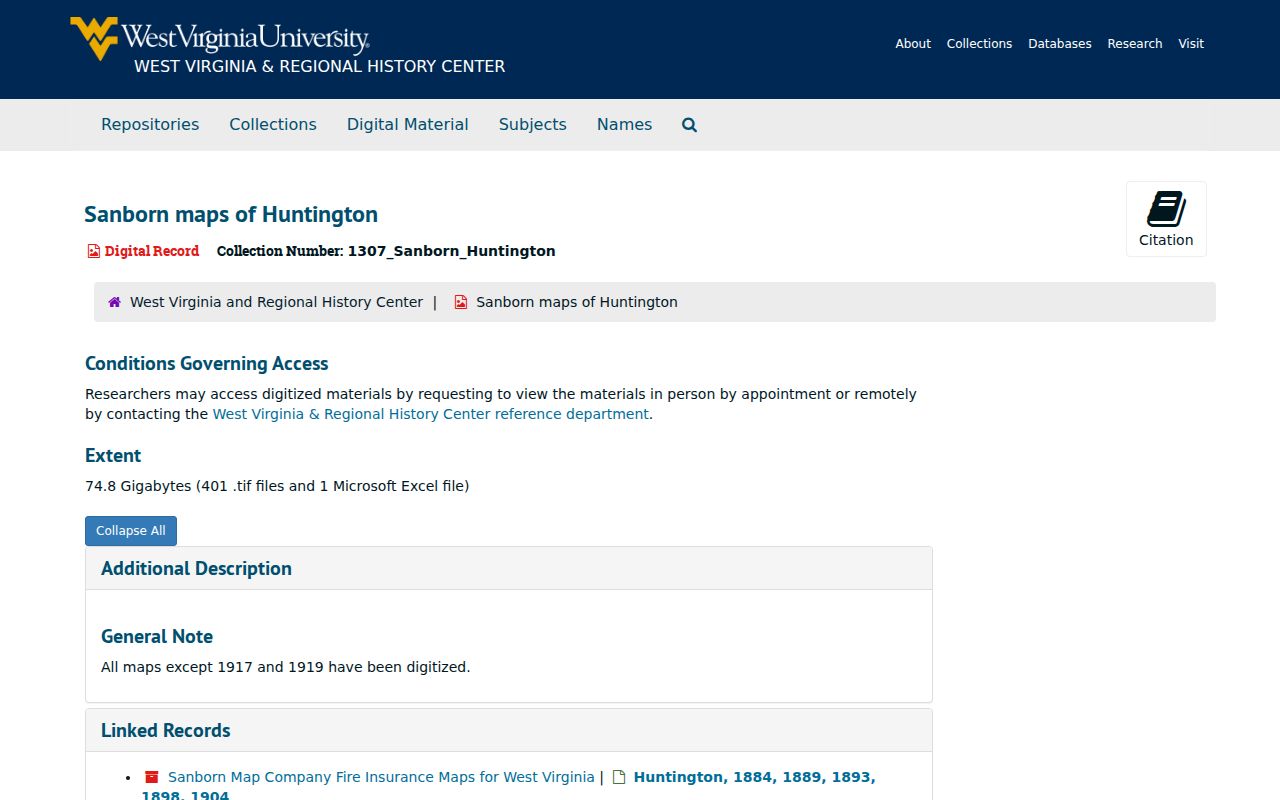
The archive entry establishes the map set and dates. An individual sheet can then show whether a building stood at the site in that edition.
Huntington Newspapers Close the Trail
Newspapers and obituaries can connect a dated person to an event, address, relative, or institution. Cabell County Public Library asks for a complete death date for obituary work. If the exact day is unknown, staff search one newspaper across five days. The Herald-Dispatch is not indexed there, so a precise publication date is needed for news research.
The State Archives Cabell newspaper inventory includes early Guyandotte and Huntington titles. Its microfilm ranges may contain selected dates or missing issues. Record the title, reel or range, and dates actually checked. An absent clipping proves only that the reviewed material did not yield one.
The Clerk's probate series can continue the path through wills, fiduciary appointments, estate claims, appraisements, and settlements. Preserve the role shown. An heir, executor, creditor, or guardian is not automatically an occupant of the property.
Huntington Past Residents in Flood Context
The local history collections hold 1913 and 1937 flood views. These images can explain a damaged building, altered street scene, or gap in a family's address trail. They add event context, not a roster of who occupied each home. Marshall Special Collections also preserves maps, flood photographs, transportation and business history, and yearbooks.
Marshall Special Collections can also help with city maps, transportation, business history, flood photos, and yearbooks. Contact the collection with a street, year, institution, or event, not a demand for an unrestricted biography. A photograph caption or school listing remains evidence tied to that item and date.
Huntington Vital Records by Age
Vital records can verify an event at the end of a historical trail, but modern certificates are not open name searches. Under West Virginia Code sections 16-5-27 through 16-5-29, birth records generally open after 100 years. Death, marriage, divorce, and fetal-death records generally open after 50 years, subject to protected fields and statutory exceptions.
Eligible requesters may use Cabell County's online ordering route for qualifying Cabell events, or state Vital Registration in person, by mail, or through its linked online vendor. Older genealogy work moves toward the State Archives. Library and archive sources cannot bypass certificate eligibility.
Pair Huntington Previous Resident Sources
Owners are only one layer. A directory may list a householder, spouse, occupation, or street entry in a particular edition. Census schedules can show a household at an enumeration date, though street indexing and public-release rules differ by census. Obituaries and church or yearbook files may add family and community context. The Huntington city directories page covers the collections and how their entries read.
- Choose the nearest available directory before the target census year and copy the entry exactly.
- Check the next available edition for a move, spelling shift, or changed street number.
- Find the corresponding census household and note its enumeration date and district.
- Test names and relationships in a dated obituary, newspaper, probate, or church-directory file.
- Compare those person records with the deed chain, while keeping ownership and occupancy separate.
A criss-cross directory is arranged by street and number, while a conventional name index begins with a surname. An enumeration district is the area assigned to a census taker. Both can help when names are hard to read, but neither fills a missing year automatically. Previous residents should be reported as dated source entries, not as an unbroken list.
Lawful use. Use Huntington house history for family research and responsible personal inquiry. Do not use old records to track, expose, harass, or harm any living person.
For records that are not online, send a narrow request to the office that holds them. The Clerk accepts counter, phone, fax, and mail contact for county series. The library has defined staff-search limits, and archives offer finding aids and microfilm. West Virginia FOIA requests belong with the public body that created or maintains the specific record, not a central clearinghouse.